Why Are People Colorblind?
Understanding the genetic and biological causes behind color vision deficiency.
Inherited Color Vision Deficiency
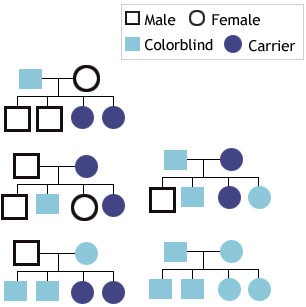
The most common forms of congenital defective color vision, the red-green deficiencies, are due to “sex-linked X chromosomes” and “simple recessive hereditary traits”. Men are mainly affected because women have two X chromosomes and men have only one X and a Y chromosome. If a man's one X chromosome is color defective he will be color deficient, where as, a woman must inherit two color defective X chromosomes to be color deficient. For a woman to be color deficient, her father must be colorblind and her mother colorblind or be a carrier. All possible patterns of inheritance are shown in the image to the left.
A color-defective male always inherits his deficiency from his mother, who usually has normal color vision and is therefore a carrier of the defect. She may have received her color-deficiency gene from either her father (but only if he was color defective), or from her mother (who could have been a carrier herself, or rarely, who was color-defective).
Rods, Cones & the Retina
The retina of the eye has two types of light-sensitive cells called rods and cones. Both are found in the retina which is the layer at the back of your eye which processes images. Rods work in low light conditions to help night vision, but cones work in daylight and are responsible for color discrimination. The exact physical causes of color blindness are still being researched but it is believed that color blindness is usually caused by faulty cones but sometimes by a fault in the pathway from the cone to the brain.
People with normal color vision have all three types of cone/pathway working correctly but color blindness occurs when one or more of the cone types are faulty. For example, if the red cone is faulty you won't be able to see colors containing red clearly. Most people with color blindness can't distinguish certain shades of red and green.
Acquired Color Vision Deficiency
Unlike inherited color blindness, acquired color blindness can vary over time. Symptoms may be mild and remain stable or they can be severe and progress to more serious forms of color blindness, such as monochromatism, very quickly. Often the cause of color blindness determines how severe the symptoms will be.
Medications: Acquired color vision deficiencies can be due to the toxicity of medications (Plaquenil, antidepressants like Prozac, oral contraceptives like Nolvadex, etc.).
Diseases: Diseases which can lead to color blindness include Alzheimer's disease, diabetes mellitus, glaucoma, leukemia, liver disease, chronic alcoholism, macular degeneration, multiple sclerosis, Parkinson's disease, sickle cell anemia and retinitis pigmentosa.
Certain drugs: Such as antibiotics, barbiturates, anti-tuberculosis drugs, high blood pressure medications and several medications to treat nervous disorders may cause color blindness.
Chemicals: Such as carbon monoxide, carbon disulphide and some containing lead can also cause color blindness.
Aging: In people over 60 years of age, physical changes can occur which might affect a person's capacity to see colors.
Take a Test
Test your color vision online now with a test developed by Dr. Terrace L. Waggoner.
Start TestQuestions? info@testingcolorvision.com